Making Ethical Decisions in a Post-Modern Technological Landscape

// Today’s post is an essay I wrote for a professional practice class. The assignment was to examine a single tenant of ASET’s Code of Ethics using a real-world example of an ethical issue. The assignment was for two pages in length – this ended up at 41/2 pages. // Continue reading

Final week of classes

Well, here we are at the end of another Winter semester. Pumpkin carrot
soup is simmering on the stove while my kitten purrs into my woolly sweater.
I have run the race to the first leg’s final sprint, and I am satisfied
with my performance. High and mid 90s nearly all around.
Next semester promises to hold much more interesting course material (and
likely more difficult!), meatier topics, and more rewarding challenges to
work through. My journey through self-forgiveness and mindfulness
continues daily, and I am thankful for the people in my life that have
supported me, encouraged me, and helped me get this far: especially my wife
Amy.

Here is to all of us who drag our asses to the finish line in expectation
of some holiday cheer and well-earned rest.

Cheers and shalom.

Eyes in the Back of Your Head.


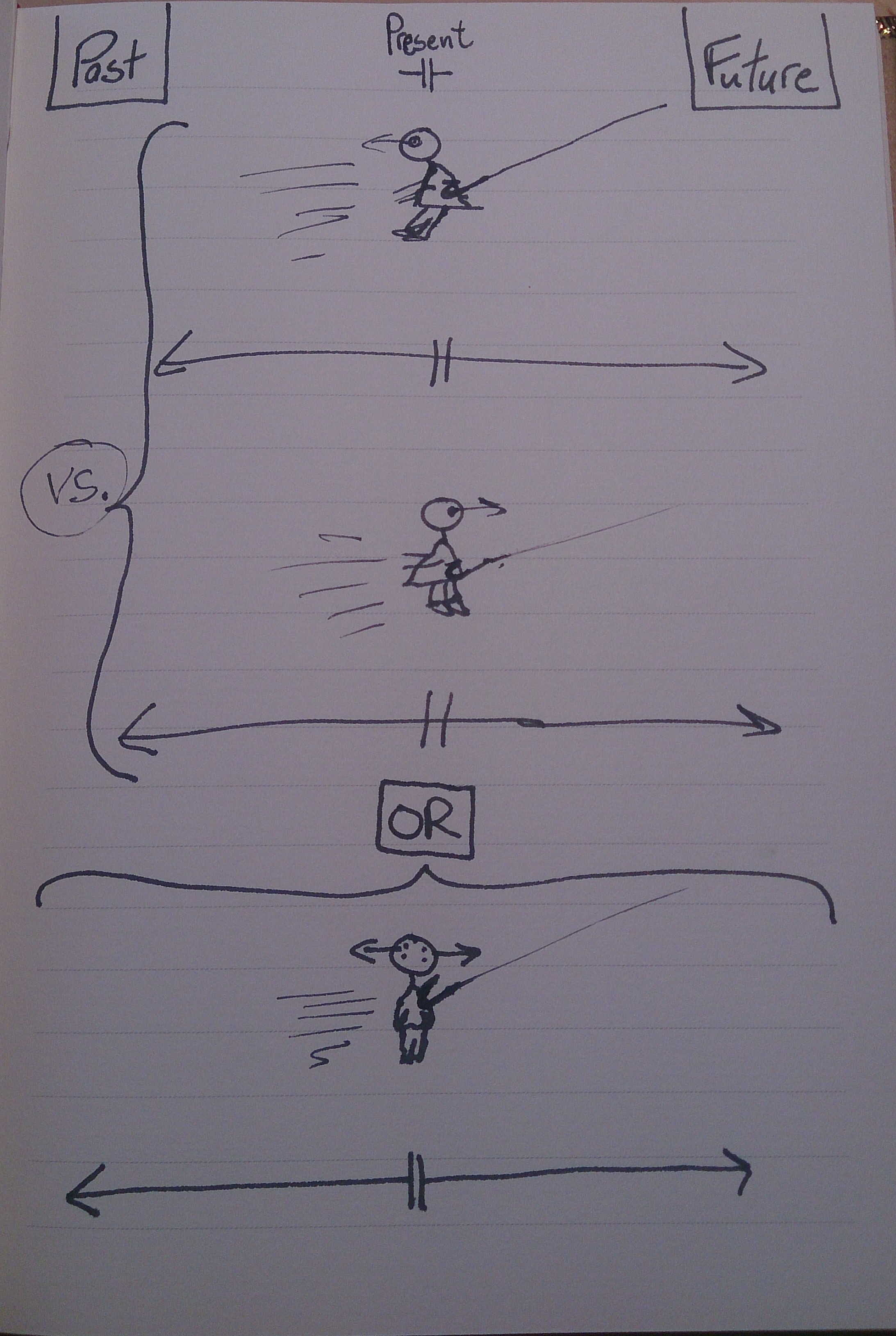
Consider the sketch I’ve attached.

PastFutureViews

The fish-hook of life has snagged on your soul’s clothes, and you’re whizzing through the timeosphere, seemingly in one direction. This is true of all of us. We move chronologically – logically through the chronos. (The cosmos [space and time], minus the space)

Being beings, we are free to choose our actions as we whizz along. Our illustrated example shows a very unisexual person experiencing his own irresistible movement through the chronos. It also shows, in the first two images, his decision to look either behind himself – to the past, contemplating, learning from experience, remembering, perhaps hurting – or ahead of himself – to the future, planning, expecting, hedging, perhaps worrying and doubting.

We’re often presented with this choice being a dichotomy: We are free to choose, but we can only choose one at a time. “Don’t look back”, “Plan ahead”, “Those who do not learn from the past are doomed to repeat it”, etc. Even if advice is not being peddled, the assumption is often the same forced choice. It makes sense – in our analogy of a physical person flying through time, the person has only one set of eyes, and they can only look one direction.

But we are thankfully not solely physical beings. Our bodies may age, fail, die and disintegrate – which is fine, by the way – but alongside our body our selves walk the silver thread of time. “Mind”, “Spirit”, “Self”, “Consciousness”, whatever it is, may be constrained in some ways by working through a physical body, but it seems to have its own characteristics. I think maybe its vision is much more flexible and adaptable than our physical vision.

As we see in the final frame of my sketch, our androgynous lady/man has sprouted a number of new eyes, and has suddenly gained the benefit of synchronous hindsight and foresight. He/She/It has escaped the dichotomy physical sight necessitates, and can make decisions based on past experiences and future expectations.

Meditate on this. Is it possible to “grow” new “eyeballs” in your soul? To gain new vantage points without losing the old?

Is such a thing even possible?

On that note, goodnight, and

Shalom.


The three keys to unlock engagement.

Well well, here we are again, together. I’m sending thoughts wooshing into your mind, and you’re hopefully paying attention to them as they fly by. Here we go!

Lately, I’ve struggled with my own inertia. I’ve set fairly strong patterns of living: functional tasks like cooking eggs, driving to work, making …”coffee” all day are cemented in my routine – which is fine. However I have other, less concrete patterns that I live out daily – I get anxious about being hungry (yeah, it’s strange), I fixate on our money supply, I fret about my future, I chase simple anaesthetic “pleasures”, I compare myself to others, I compete with my wife, and on, and on, and on. These patterns define me, because they seem to decide how I act to others, myself and the world around me. And it seems as though they do it all by themselves.

Inertia does its best to keep me travelling paths I travelled yesterday. If I lose mindfulness of my living – ohsoeasy to do, like dandelion seeds in a tornado –  inertia’s smothering weight bears down on me and before I know it a week has passed; I’ve not exercised, I’ve not connected with any of you fine people, nothing is done, and no memories are created. I surface on some evening evening with a gasp, and looking around me I cringe at how hard I slipped, how much fell through the wide cracks.

Not to worry though: We all have (starting right now this very second check it out!!) an opportunity to gently take inertia aside and set a new course for ourselves. The great thing about inertia is it’s mindless – you teach it where to go, and it just barrels on ahead face down like a stupid angry cow or something (no offence to the intelligent cows of our communities) when you slacken the reins.

So take heart, you who are weary and splintered of mind. Take a breath.

A deep breath.

Another. Deep. Breath.

And out of that breath let flow down the mountain of inertia even a tiny, burbling stream of intent. Not advertisers’ intents nor your parents’ intents nor your anxiety’s intent. Your intent is all you need to begin.

What you begin is up to you!


As I said, I’ve struggled with my untrained inertia getting the better of me. So lately, I’ve been carving time to reflect and write down what bubbles up from my soupy consciousness. I’ve come up with a list of three fairly actionable items which I hope will help me train my inertia towards mindfulness, beauty and abundance. Perhaps they’ll help you out if you’ve been finding yourself at the beck and call of frustrating meaningless lately.

Or perhaps not.

Either way, here they are. I’ll write more about them soon, especially the relationship between creating and consuming. Have a great week, everyone.


 Create in accordance with your consumption.
Consume in accordance with your mindfulness.
Be mindful of all, always, all ways.

Magic.

Writing words is casting a spell: you form the interface between an idea and a reality. Your hand is your wand. Wave it about recklessly! Fire, sparks, lightning!! – they rush out like so much water through a smashed dam!

And don’t be afraid – you won’t hurt yourself. You endanger no one with your loose word cannon. Like the wind, it would take a monumental amount of energy to do damage. Unless a tornado forms, the wind simply makes itself known – it does no harm.

So be brave, magician. Take up your wand with curiosity, nobility! You’ve received a gift from higher planes: you create the future. You control the present solely with your mind! Until you think it (whether you’re aware you’ve thought it or not!), it doesn’t exist. But-! Once your mind has conceived it, it chomps at the bit, claws at the door, to burst into reality!

Open the door! Let it run wild! Yours is the day, the opportunity, the energy!


A Birthday Post

(Ed. Note: This post was meant to be published on Dec 19)

Today is my Eleventy-First Birthday!

Actually, it’s not. It’s my twenty-third birthday! 

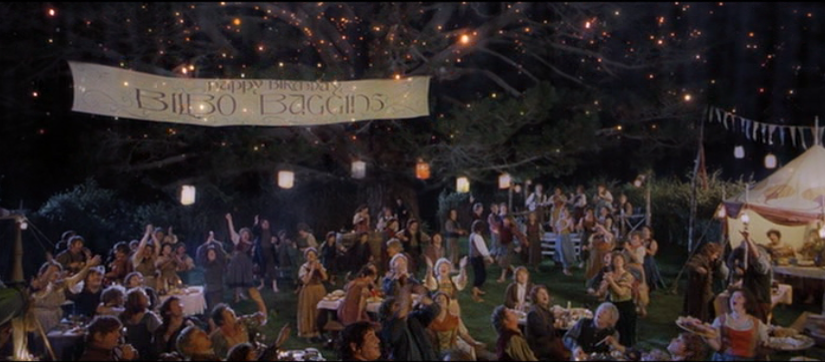
I feel ready for a Hobbit-sized party, with barrels of drink, mountains of food, rivers of dessert and of course, hordes of close friends and family.

Like This!

Like This!

Unfortunately, the order of today’s society is to spread out from each other and follow different schedules – this makes it difficult to throw a party and organically see it grow and take off. The amount of effort it would require would pale Bilbo’s fat cheeks.

Communities are not what they used to be. I don’t even mean that in a crotchety old man way: “Communities suck these days! Everyone curses and has tattoos!” I mean communities have evolved with society to be far-reaching categories of people not confined geographically. Technology has certainly played a pivotal role in facilitating this transition, and I can’t say I’m surprised: people need to feel close to each other, even when they’re far away. Why do you think I’m writing this?

I need connections with people – I’m socially extroverted. On days that I feel lonely, sometimes I go sit in a coffeeshop just to feel near others. It’s why I play online games – it’s a community of sorts. Online communities don’t quite fill the need for real people, but it’s better than moping around an empty house (some might argue I’d be better off alone with my thoughts).

It’s why I decided to share this publication with you. I hope in some way it helps you feel more connected to me. I hope it encourages you to reach out to others in your communities and strengthen those connections.

We need more hobbit in our lives, we really do. I can’t speak for introverts, but I am married to one, so I know that too much partying, drinking, dancing, smoking of pipes and general carrying-on can wear some of you out sooner than others. That’s why as much as they love to cause shenanigans and letting down of hair, hobbits appreciate a quiet breakfast with a select few confidants. They grab their favourite walking-stick and trot about the countryside for hours, just because it’s there for the enjoying (they also need to work off their vast food intake). A whistling kettle calls them to sit comfortably with a lovely book, to slow down and reconnect with something real.

The Mahāyāna Mahāparinirvāṇa Sūtra, a major Mahayana Buddhist ‘scripture‘, speaks of humans having Buddha-natures: “a sacred nature that is the basis for [beings’] becoming buddhas.” What if we also have hobbit-natures? Those of us who’ve read Tolkien’s works know what hobbits are all about – those of you who haven’t, must. Somewhere in each of us could lie the potential to become a hobbit! To my eyes, there can’t possibly be a downside to nurturing our hobbit-y habits.

So, find your hobbit-nature this week. Christmas is coming, families are gathering, food is plentiful (for most of us), drink is abundant (especially in my family), and the air is thick with love and cheer.

What a lovely time to embrace a hobbit-nature.

Shalom.

A One Cup sort of Girl

Late last week I discovered a business model that greatly interested me. That’s an understatement – I’m obsessed.

It’s generally how I operate.

I discover something → I enjoy it → I engage it deeply → I wake up a week later to realize I’m completely adrift when the drive leaves as it came: suddenly.

(I’m sure “I talk my wife’s face off incessantly about it” fits in there as well)

Having just completed yet another introductory Psychology course, I suspect that if my pattern of intense fixation followed by sudden protracted apathy were considered to be deviant, dysfunctional or distressing, I could be labelled with Bipolar or Manic-Depressive Disorder. Certainly, my manias are not elevated into psychotic states, but I do experience periods of heightened energy and focus (often to the exclusion of more normal pursuits) on a single idea, activity or pursuit. Shortly afterwards, I find my momentum slow, stall and putter to a quiet death, and I slip into a generally apathetic state that occasionally deepens into a more depressed mind-space.

Perhaps this is a fairly common cycle many people go through in varying intensities and varying time frames.

Lately, I’ve been thinking about drive. About where the WHOOOSH to do something comes from. I wonder if it has its own timeline and itinerary, and I wonder if it takes our plans into consideration. Maybe it behaves like the stubborn bull. Or has it the lamb’s gentle nature?

Tim Ferriss, author of the 4-Hour Work Week, suggests that manic-depressive behaviour is often characteristic of entrepreneurs, and he goes so far as to encourage wrangling it into serving one’s goals by “activity pairing”. That is, matching your present position on the rollercoaster with synergistic activities. For example, advertise and publicize when you’re feeling wildly optimistic, but avoid large spending decisions. Likewise, budget and forecast during the post-high descent, but absolutely do not engage in media output. In effect, stop working against your tendencies and help them work for you – develop a two way street between who you want to be and who you really are.

An attitude of being in control of your behaviours and making decisions for those around you is not presented as desirable or even possible in the media and in the broader culture of our time. Of course it isn’t – the modern paradigm of consumerism requires us to accept the reality that we’re given and conform to it. But we desperately need to challenge this status quo. Pete Michaud, whose writings I admire, speaks to this need. Michaud references John Nash’s Equilibrium, a subset of the economic study of Game Theory. Game Theory examines the decisions of individual players in a “game”, the rules of the game (such as laws) and how the players’ interactions with each other and the rules emerge as groups that have their own behaviour within the game. Nash postulated that an equilibrium exists in game theory “in which all the players of a game play optimally given the strategy of the other players.” Individual players (in this case, we are all individual players in our communities, churches, schools, workplaces, etc.) will develop the most optimized strategy they can find in relation other players’ strategies. In effect, we determine our best way of life by observing those around us.

However, people are not individual players in the great game of life. This is because we are too small to play the game ourselves. We are players in the organizations, countries, affiliations, and other groups we belong to, which are in turn the players in the world at large (the Global Game). This realization, as Michaud points out, is a drastically new lens to see our lives through. As individuals who exert no significant influence on the Global Game, our decision are largely inconsequential to its machinations and we are therefore free to move in our choosing through the world. As long as we don’t cause disruption amongst the larger players of the game (governments, large corporations, big organizations and such), we can disrupt the smaller patterns without major negative consequence. For example, organizing a rebellion that causes a war would have significant consequences to you. But arranging a remote work agreement with your employer in order to travel (your benefit) while being productive for him/her/it (their benefit) is not going to cause great turmoil at large and so the Global Game will leave you alone.

Disrupting the status quo often means ignoring rules of society that keep you from your dreams. Michaud lays a framework for deciding which rules you should ignore, and which you shouldn’t. If the main argument against breaking the rule is something along the lines of “if everyone did that, [negative consequence]”, chances are you can break that rule because you know that hardly anyone breaks rules like that (Michaud uses the example of printing counterfeit money). As an inconsequential player, breaking the rule has no significant effect on the Global Game. The key to this reasoning is that the system has no underlying moral imperative – it only wants to stay in equilibrium. If you can execute an action that technically breaks a rule, but doesn’t disrupt the system, then you have to apply your own ethics and morality to the question of whether to execute. The system that is telling us how to live our lives is a “conspiracy of none” – it’s only trying to stay stable. There are no evil dudes pulling the strings (sure, there are players that jockey for position is the Global Game, often with underhanded techniques), no secret board of shadowy figures using mind control – the system that has been built over thousands of years of biological, technological, and organizational evolution just wants to stay where it is.

Call it inertia.

It’s (always been, and always will be) time to stop taking our orders from a mindless system and embrace the freedom we all have by virtue of being alive. Develop your morality by testing it. Test it by asking “What would be the real consequence to me, my sphere of influence, and the system at large if I broke this rule I’ve been told to never break my entire life?” Be honest with yourself. Think for yourself (Think by writing, too)

Meditate on the meaning of freedom.

Don’t take orders from me or anyone else – do whatever the hell you know to be right and best for you.

My wife likes to drink a cup of tea. I like to drink a pot of tea. It’s very rare for her to ask for a refill, which of course leaves more for my slurping. We know that we complement each other well in many ways, and this is certainly one of them.

It’s funny how something like tea drinking habits can illuminate larger behaviours you’ve been trying to get a good look at. I consider myself a bon viveur, one who enjoys life to its fullest by imbibing generously and always asking for seconds. A long walk is the only good walk, preferably away from concrete and houses. Getting lost is bonus.

Basically, I’m a hobbit.

My wife (who prefers to remain nameless – understandably not wishing to be associated with my strange self) seems to enjoy tempered desires. One cup of tea, thank you, that’ll be enough. I won’t eat that much popcorn, dear, make less (of course I don’t make less – I eat the excess). Just a short walk around the block to get some fresh air. No, don’t bring a map, we’re not going on an adventure. In fairness, she does like to adventure in the summer.

She’s certainly more of an elf.

I’m trying to decide if this difference is meaningful – if perhaps my arms are a bit too rubbery when impulses come a-twisting. Maybe she’s a bit too suppressed and needs to open up to life in general, or her fears are sneaky, sabotaging and unknown to her.

That’s all I’ve got to say, because the (definitely overfilled – oops) slow cooker is infusing my house with the meaty aroma of spaghetti sauce and it’s time to eat lunch.

Shalom
 

Meet Playful the Dog

Good morning, dear friend.

Are you awake yet? Are you really awake?

Is your energy still in bed? Are you dragging it behind you by a rope?

Or is it pulling you forward to meet your day like a crazed bloodhound?

Have you begun to connect with other people, in your home, in your devices? Has anyone reached out to you yet? Perhaps you still nurture the peaceful isolation that swells with the glory of sunrise, and you allow yourself to fill with warm, grounded energy. I feel it flow through my feet from the earth, making its way to my heart, warming me to myself and the world around me. God, thank You for this blessing.

Maybe you’ve had poor sleep, troubled dreams, an early start or a fractured morning. You wish you could crawl back to bed and just try again tomorrow morning. Your breakfast is unhappy in your stomach and your head moans in protest. The strange thing about mornings such as these is they are often no indication of the coming day – you may feel drained until bedtime, but it’s as likely you soon get a burst of energy and feel right as rain. I wonder what determines the path we follow. Is it a manifestation of our will? Can we “get over” our physical aches and transform our mood? Or is it out of our control – the whim of our environment and our genes, maybe the spiritual world withholding or showering blessings?

Energy is an animal inside of us, albeit a trainable one. If let run wild, it can lead us nowhere we wish to go, even so far as to get us lost for hours in the land of waste.

But, if we spend time guiding our energy, we can train it to listen to our commands. We can set the course with declared intent and then, like the scent-fixed bloodhound, run with it. And we take turns leading the way – sometimes our energies need a nudge to get back on the trail, sometimes we need a tug to remember we’re moving forward. Don’t forget to stop along the way, both to observe where you are in this moment, and to gaze upon your destination. Knowledge of your current whereabouts in relation to where you want to end up is imperative to finding the path. Duh.

But, how do we train our energy, our focus, our faithful hound? How do we remember to get our bearings? The answer is simple, but it’s not always easy.

Meditation.

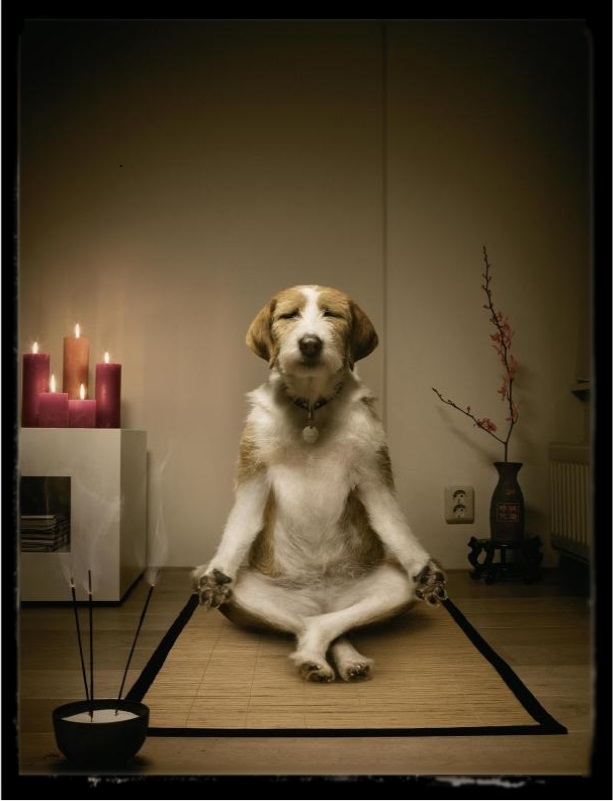
While not a bloodhound, dogs are known to enjoy traditional meditation practices.

Meditation in all its forms.

| Prayer with God | Loving-Kindness | Single-focus |

| Walking meditation | Mantra chanting | Breathing exercises |

| Physical exercises | Writing | Your Meditation Style Here |


The simple act of paying attention to what you’re doing, where you are, and what’s happening, without judging what you find, will temper your focus. Actually, it will freely shower you tools to guide your energy, and you’ll be asked nothing but your time and attention in return. You will learn where your energies grow from. You will learn what nurtures them, and you will learn what hampers their development. Functionally, you’ll have more control over them in your life in the real world, and they will serve you more faithfully at unexpected times in unexpected ways.

I see this as a spiritual practice. For me, meditation creates space in my heart and mind for the Creator to expand and breathe His Word into my soul.

Each of us is offered this blessing freely, and we need not even reach out to claim it. We need only create space and time for Him to place in us what He desires.

For it is by grace alone we are saved. Not by our works. So it seems natural that “doing by not doing” (wu wei, a Taoist principle) through meditation is an acceptable way of receiving the Grace of God.

I meditate at least once a week on purpose. I find myself in little slices of meditative moments daily, and I actually enjoy those more. It’s like the universe has a Playful element that likes to surprise you in only the best ways and make you laugh. For me, meeting Playful throughout my day keeps me sane and happy. I love to share him with others, and watch them laugh too.

I’d say you should keep a lookout for Playful, but that would do no good.

Be assured, though, he’s keeping a lookout for you.

Shalom.